
Personalization in webinars has always been a tradeoff. The more personalized the experience, the more manual work it required. You could create different webinars for different audience segments — but each one needed its own script, slides, recording, and follow-up. The cost scaled with the personalization. Most businesses settled for one webinar for everyone because the alternative was impractical.
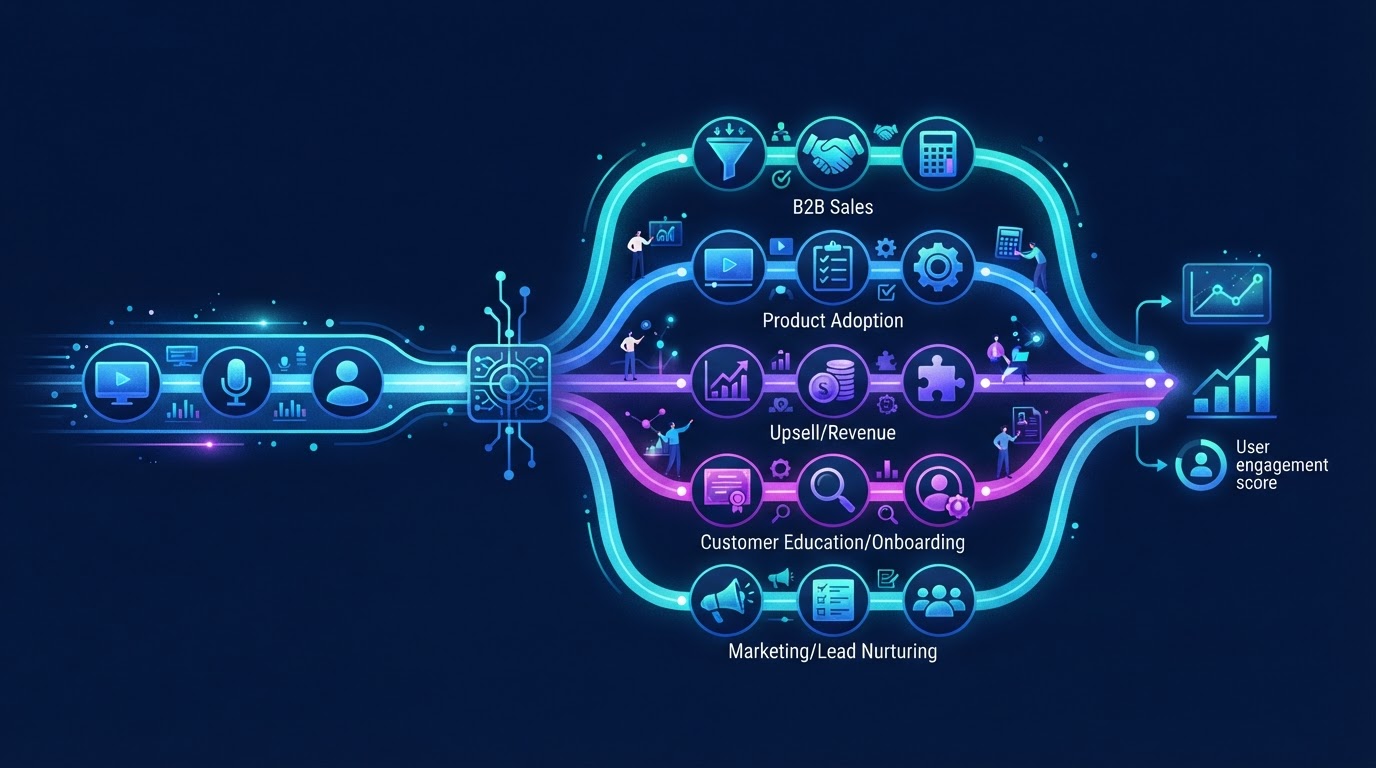
AI is changing this tradeoff. Personalization no longer requires creating multiple presentations. One webinar can produce a different journey for each attendee — through AI Q&A that responds to individual questions, behavioral follow-up that adapts to individual actions, and offer presentation that adjusts to individual signals. The personalization happens automatically, at scale, from a single created presentation.
Three layers of webinar personalization
Personalization in an AI-powered webinar happens at three layers: during the presentation, through the Q&A, and through the follow-up. Each layer adds a different kind of personalization, and together they create an experience that feels individual without requiring individual production.
Layer 1: AI Q&A personalization
During the webinar, the AI Q&A personalizes the experience by responding to each attendee's specific questions. Two attendees watching the same presentation may ask completely different questions — one about pricing, one about integrations, one about a specific use case. The AI answers each one individually, drawing from the knowledge base. The presentation is the same. The experience is different.
This is the most immediate form of personalization. The attendee does not fill out a form or select a segment. They simply ask what they care about, and the AI responds to that specific concern. The personalization is driven by the attendee's own behavior, not by a pre-assigned category.
Layer 2: Behavioral follow-up personalization
After the webinar, the follow-up personalizes based on what each attendee did. An attendee who watched 90% and asked about pricing receives a different follow-up than one who watched 10% and asked nothing. An attendee who clicked the offer receives a different message than one who did not. The follow-up is tailored to the attendee's demonstrated interest, not to a generic sequence.
This personalization is behavioral — based on actual actions, not self-reported preferences. It is more accurate than asking attendees to segment themselves, because people's actions reveal their intent more reliably than their answers. The attendee who clicked the offer is signaling buying intent, whether they say so or not.
Layer 3: Offer personalization
The offer itself can be personalized based on the attendee's signals. An attendee who asked about a specific feature receives follow-up emphasizing that feature's value. An attendee who asked about pricing receives follow-up addressing the pricing objection. An attendee who asked about a specific use case receives follow-up with a relevant example. The offer is the same. The emphasis is different.
Personalization at scale does not mean creating multiple presentations. It means one presentation that adapts to each attendee through AI Q&A, behavioral follow-up, and offer emphasis. The personalization is automatic, driven by the attendee's own behavior, and requires no additional production.
Why behavioral personalization beats demographic personalization
Traditional personalization is demographic — different content for different job titles, industries, or company sizes. This requires the attendee to provide demographic data, and it assumes that demographics predict needs. They often do not. Two marketing directors at similar companies may have completely different problems.
Behavioral personalization is based on what the attendee actually does — the questions they ask, the sections they watch, the offers they click. This is a direct signal of interest, not a proxy. It does not require the attendee to fill out a form. It does not assume that people with similar demographics have similar needs. It responds to the individual's demonstrated intent, in real time.
The result is more accurate personalization with less friction. The attendee does not self-segment. They behave, and the system personalizes based on that behavior. The personalization is invisible to the attendee — they simply experience a webinar and follow-up that feels relevant to them specifically.
The data advantage
Behavioral personalization generates data that demographic personalization does not. Every question an attendee asks, every section they watch or skip, every offer they click — these are signals that reveal what the attendee cares about. Over time, this data accumulates into a picture of what your audience actually wants, not what you think they want.
This data can improve the webinar itself. If 40% of attendees ask about pricing, the presentation should address pricing more explicitly. If attendees consistently drop off at a specific section, that section needs restructuring. If a particular question comes up repeatedly, it should be added to the FAQ or addressed proactively in the presentation. The personalization data becomes a feedback loop that improves the webinar for every future attendee.
What personalization cannot do
Personalization cannot replace the human conversation for high-stakes decisions. An AI-personalized webinar can educate, engage, and qualify — but for complex sales that require trust, negotiation, or customization, the webinar feeds into a human consultation. The personalization makes the consultation more productive (the prospect arrives educated and qualified), but it does not replace the consultation itself.
The goal of webinar personalization is not to automate the entire sales process. It is to ensure that each attendee receives the most relevant experience possible from a shared presentation — so that the ones who are ready convert automatically, and the ones who need a human conversation arrive at that conversation better prepared.
See AI webinars in action
Watch how WebinarBoostAi creates, presents, and engages with webinars using AI.
Book A DemoFrequently Asked Questions
What is webinar personalization?
Webinar personalization is tailoring the webinar experience to each attendee. In AI-powered webinars, this happens at three layers: AI Q&A (responding to individual questions), behavioral follow-up (different messages based on attendee behavior), and offer emphasis (tailoring the offer presentation to individual signals). It requires no additional production — one presentation adapts to each attendee.
How does AI personalize webinars?
AI personalizes through behavior, not demographics. The AI Q&A responds to each attendee's specific questions. The follow-up adapts to what each attendee did (watch time, questions asked, offer clicks). The offer emphasis adjusts to the attendee's signals. The personalization is automatic, driven by the attendee's own actions, and invisible to them.
Is behavioral personalization better than demographic personalization?
Usually yes. Demographics assume that people with similar titles or industries have similar needs — they often do not. Behavioral personalization is based on what the attendee actually does, which is a direct signal of interest. It is more accurate, requires less friction (no forms), and responds to real-time intent.
Can webinar personalization replace sales calls?
For self-service offers, partially. For complex sales that require trust, negotiation, or customization, no. Personalization makes the sales call more productive — the prospect arrives educated and qualified — but it does not replace the human conversation for high-stakes decisions.
What data does webinar personalization generate?
Behavioral data: the questions attendees ask, the sections they watch or skip, the offers they click. Over time, this reveals what your audience actually cares about. If 40% ask about pricing, the presentation should address pricing more. If attendees drop off at a specific section, it needs restructuring. The data becomes a feedback loop that improves the webinar.