
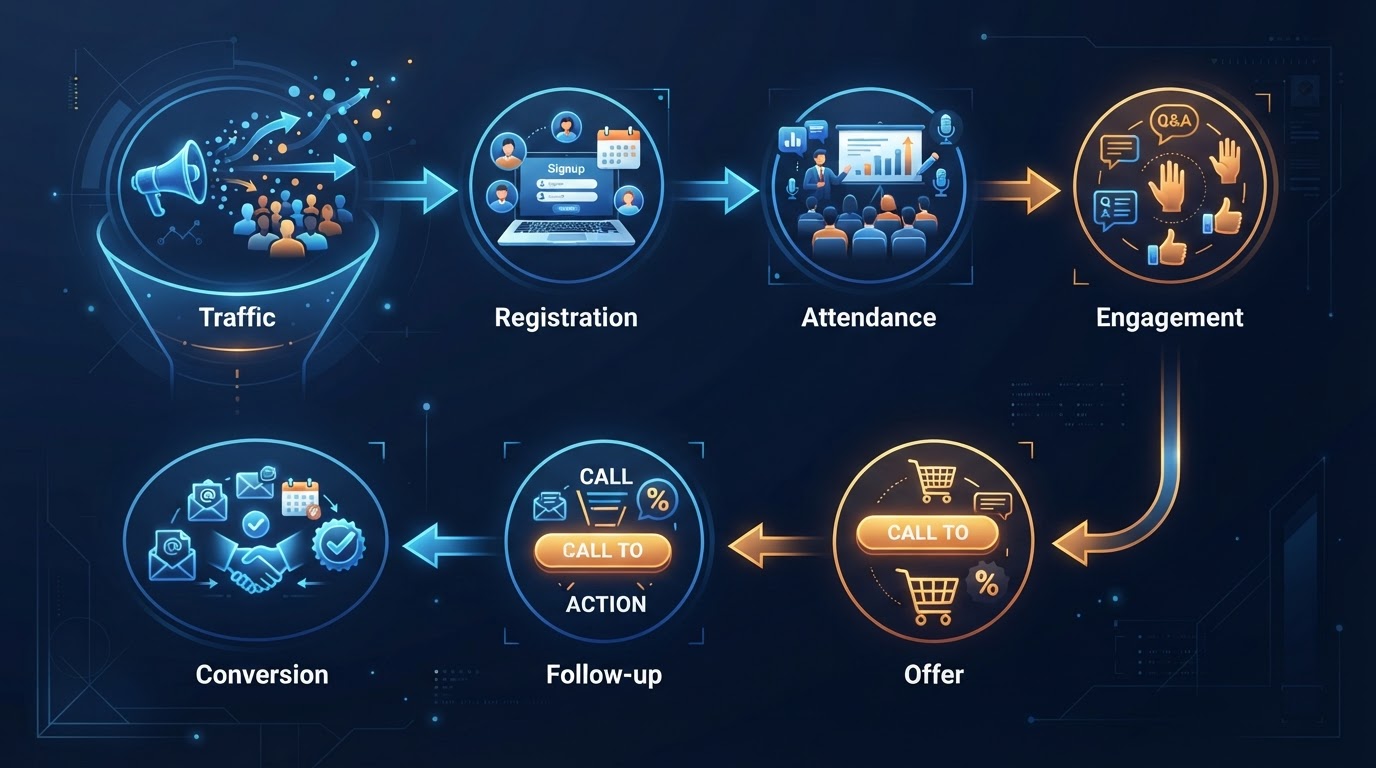
A webinar funnel is a system. It has stages, conversion rates between those stages, and points where attendees leak out. Most businesses build only two stages — the registration page and the presentation — and wonder why the funnel does not convert. The reason is that the other four stages are missing or broken.
Here is the complete blueprint: traffic, registration, attendance, engagement, offer, and follow-up. Each stage has a job. Each stage has a conversion rate. Each stage can leak. Build all six, and the funnel converts continuously. Build only two, and it does not.
Stage 1: Traffic
Traffic is how people find the webinar. Without traffic, the funnel has no input. The sources are paid ads, organic search, email lists, social media, and referrals. Each source has a cost — money for ads, time for organic, list size for email — and a quality level.
The key decision is which sources to invest in. Paid ads drive traffic quickly but at a cost that must be justified by downstream conversion. Organic search drives traffic slowly but sustainably and at a lower cost per lead. Email drives traffic at the lowest cost but is limited by list size. The strongest funnels use multiple sources — paid for speed, organic for sustainability, email for efficiency.
For an evergreen or just-in-time webinar, traffic flows continuously into the same registration page. The webinar runs on the attendee's schedule, so traffic from any source at any time converts. This is what makes the webinar a persistent asset rather than a one-time event.
Stage 2: Registration
Registration is the first conversion. The visitor lands on the registration page and decides whether to give their name and email in exchange for attending the webinar. The registration page must communicate the value clearly: what the attendee will learn, who it is for, and why it matters now.
The registration form should ask for the minimum information needed. Name and email are usually sufficient. Every additional field reduces the registration rate. The qualification happens during the webinar — through behavior — not through the form.
The registration rate depends on the alignment between the traffic source and the webinar topic. Traffic from a search for 'how to create a webinar' will register at a higher rate for a webinar about webinar creation than traffic from a generic ad. Match the traffic to the topic, and the registration rate improves.
Stage 3: Attendance
Attendance is the conversion from registrant to attendee. This is where most funnels leak the most. The registrant signs up, waits for the session, and does not show up. The longer the wait, the lower the attendance rate.
Two strategies address this. First, just-in-time options — starting the webinar within minutes of registration, capturing intent at its peak. Second, effective reminders — email and SMS sequences that keep the webinar top-of-mind between registration and the session. The combination of just-in-time and reminders produces the highest attendance rates.
For evergreen webinars, the session schedule matters. Offering multiple session times — including evenings and weekends — accommodates different schedules and time zones. The more options, the higher the attendance rate. But each option dilutes the cohort size, which can reduce the event feel. Test the balance.
Stage 4: Engagement
Engagement is the attendee's active participation during the webinar. An engaged attendee — one who watches to the end, asks questions, clicks polls — converts at a dramatically higher rate than a passive viewer who drops off early. Engagement is the mechanism that drives downstream conversion.
In automated webinars, AI Q&A is the primary engagement driver. The attendee asks a question, gets a real-time response, and becomes a participant rather than a viewer. Polls, handouts, and timed offers supplement the AI Q&A, breaking the passive viewing pattern at regular intervals.
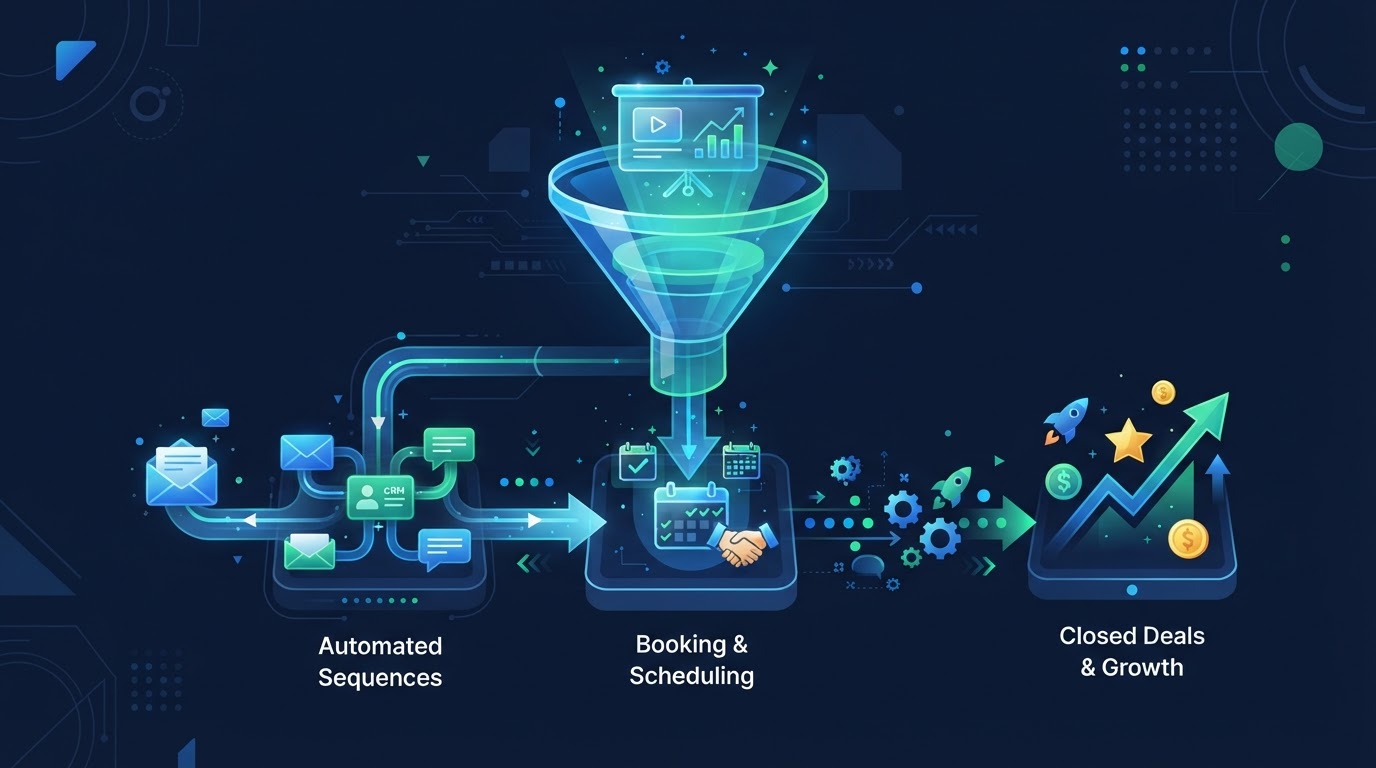
The webinar funnel is a system with six stages. Each stage has a conversion rate. Each stage can leak. The funnel's overall conversion is the product of all six rates — which means a 50% leak at any stage cuts the final result in half. Build all six, measure all six, and optimize the weakest.
Stage 5: Offer
The offer is what the attendee gets when they act. It is the call to action — book a consultation, start a trial, purchase the product. The offer must be clear, specific, and compelling. A weak offer caps the funnel's conversion, no matter how strong the earlier stages are.
The offer should be introduced before the end of the webinar, not just at the end. An early mention gives the attendee something to think about throughout the session. The explicit offer — with price, guarantee, and deadline — comes at the end, but the seed is planted earlier. The attendee should see the offer coming, not be surprised by it.
The offer click is the key conversion metric at this stage. An attendee who clicks the offer has signaled intent to act. The funnel's job from this point is to reduce friction between the click and the completed action.
Stage 6: Follow-up
Follow-up is the communication that happens after the webinar. This is where the majority of conversions actually happen, because most attendees do not act during the session. They act after, when the follow-up gives them the right push at the right time.
Behavioral follow-up — segmented by attendee behavior — is the standard. No-shows get the replay. Partial viewers get content. Full viewers get a direct CTA. Offer-clickers get a reminder with risk reduction. Each segment gets a different message because each is at a different stage of intent. One sequence cannot serve all four.
The follow-up should be immediate — within an hour of the webinar ending — and automated. Manual follow-up cannot respond fast enough, especially for webinars that run outside business hours. The attendee's interest decays every hour. Automated behavioral follow-up captures that interest before it fades.
Measuring the funnel
Each stage has a conversion rate. Track all six: traffic-to-registration, registration-to-attendance, attendance-to-engagement, engagement-to-offer, offer-to-conversion, and overall registration-to-conversion. The weakest stage is the one to optimize first — because the funnel's overall conversion is the product of all rates, improving the weakest stage has the largest impact.
This is the blueprint. Six stages, each with a job, each with a rate, each with potential leaks. Build all six, measure all six, and optimize the weakest. The webinar funnel that does this converts continuously — on autopilot, on every attendee's schedule, with engagement and follow-up handled automatically.
See AI webinars in action
Watch how WebinarBoostAi creates, presents, and engages with webinars using AI.
Book A DemoFrequently Asked Questions
What is a webinar funnel?
A webinar funnel is a system with six stages: traffic (how people find the webinar), registration (converting visitors to registrants), attendance (converting registrants to attendees), engagement (active participation during the session), offer (the call to action), and follow-up (post-webinar communication). Each stage has a conversion rate and can leak.
How do I build a webinar funnel?
Build all six stages: drive targeted traffic to a registration page, minimize form fields, offer just-in-time sessions and reminders to maximize attendance, use AI Q&A and polls for engagement, present a clear offer with urgency, and send behavioral follow-up segmented by attendee behavior. Measure conversion at each stage and optimize the weakest.
What is the biggest leak in a webinar funnel?
Registration-to-attendance. Most registrants who do not convert are lost between registration and the session — the gap where intent decays. Just-in-time sessions (starting within minutes of registration) and effective email/SMS reminders are the two strategies that address this leak.
What is an evergreen webinar funnel?
An evergreen webinar funnel runs continuously — the same presentation plays on a recurring schedule, and traffic from any source at any time flows into the same registration page. With AI Q&A for engagement and automated behavioral follow-up, the funnel converts on autopilot without requiring the presenter's time.
How do I measure webinar funnel performance?
Track conversion rates at each stage: traffic-to-registration, registration-to-attendance, attendance-to-engagement, engagement-to-offer, and offer-to-conversion. The overall conversion is the product of all rates, so the weakest stage has the largest impact. Optimize the weakest first.