
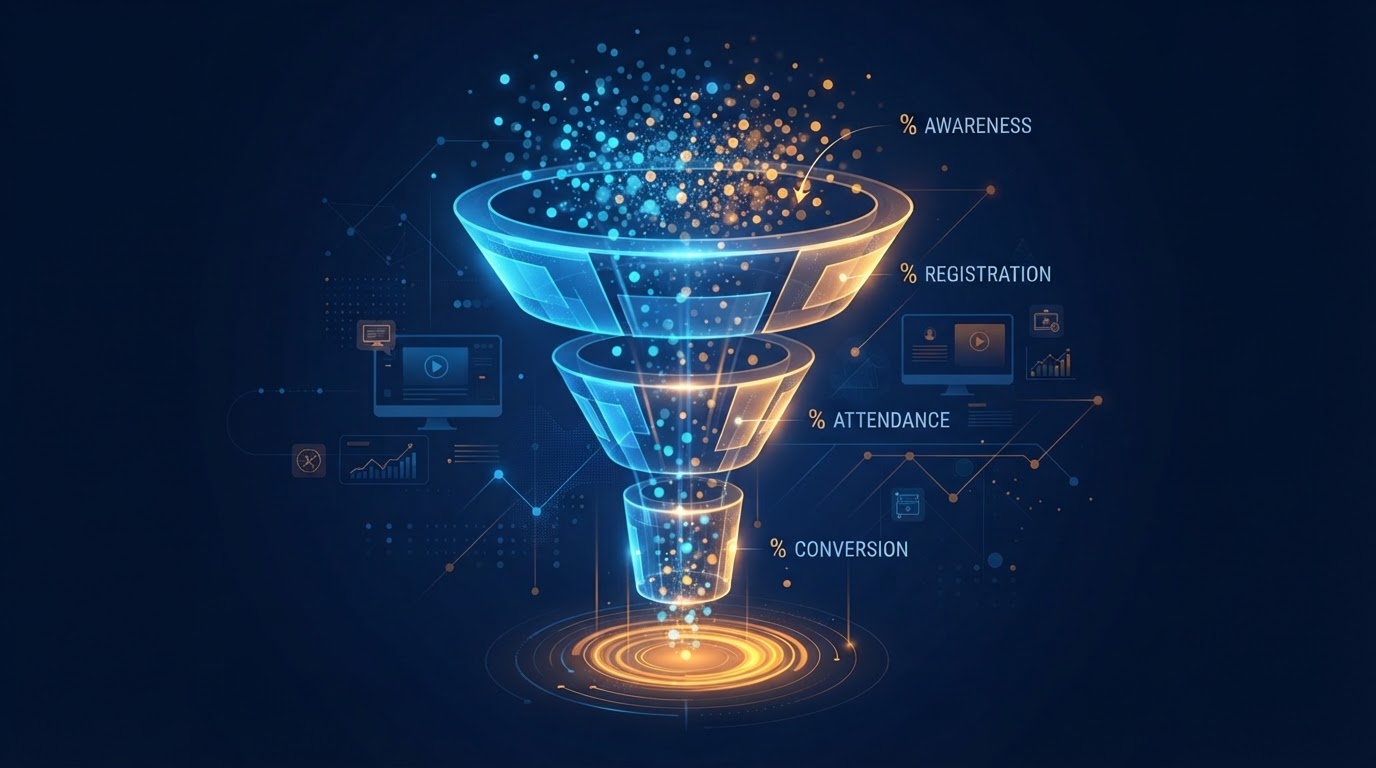
Webinar conversion rate optimization is usually discussed as a set of tactics: add a countdown timer, use a stronger CTA, create urgency with a limited offer. These tactics can help, but they miss the structure. Conversion is not a single moment. It is the result of six levers that work together throughout the entire webinar experience.
If any lever is weak, the webinar underconverts — no matter how strong the others are. A great presentation with a weak offer will not convert. A great offer with weak follow-up will not convert. A great follow-up with a weak presentation will not convert. The levers are interdependent. Here are the six, and how to optimize each.
Lever 1: Presentation structure
The presentation structure determines whether the attendee arrives at the offer ready to act. The structure should build a logical case: problem, agitate, educate, solution, offer. Each section should answer a question the attendee is asking and create the question the next section answers. The attendee should feel the presentation moving toward a conclusion, not wandering through topics.
The most common structural mistake is front-loading the education and back-loading the offer. The attendee sits through 45 minutes of content, then gets a 5-minute pitch at the end. By that point, they are fatigued. The offer should be woven throughout — introduced early, justified throughout, and made explicit at the end. The attendee should see the offer coming, not be surprised by it.
Lever 2: The offer
The offer is what the attendee gets when they act. It is not the product — it is the transformation the product enables, packaged with the terms that make acting easy. A strong offer has four elements: a clear outcome, a clear price, a clear guarantee or risk reduction, and a clear deadline.
The outcome answers: what will my life look like after this? The price answers: what does it cost? The guarantee answers: what happens if it does not work? The deadline answers: why should I act now instead of later? If any of these is unclear, the attendee hesitates. Hesitation is the enemy of conversion.
Lever 3: Urgency
Urgency is the reason to act now rather than later. Without it, the attendee leaves the webinar intending to act — and never does. The intent decays. Life gets in the way. The opportunity passes.
Legitimate urgency comes from real constraints: a limited-time bonus, a limited number of spots, a price that increases after a deadline. Artificial urgency — fake countdowns, false scarcity — damages trust and should be avoided. The urgency must be real, and it must be communicated clearly. The attendee should know exactly what they lose by waiting.
Lever 4: Engagement
Engagement is the attendee's active participation in the webinar. An engaged attendee — one who asks questions, clicks polls, interacts with the chat — converts at a higher rate than a passive viewer. Engagement signals interest, and interest predicts action.
AI Q&A drives engagement in automated webinars by making the chat interactive. When the attendee asks a question and gets a response, they become a participant, not a viewer. Polls, handouts, and timed offers serve the same purpose — they break the passive viewing pattern and turn the attendee into an active participant. The more the attendee does during the webinar, the more likely they are to do something after it.
Conversion is not a single moment at the end of the webinar. It is the cumulative result of structure, offer, urgency, engagement, follow-up, and friction — working together from registration to action. Optimize all six, or the weakest one caps your results.
Lever 5: Follow-up
Follow-up is the communication that happens after the webinar. As covered in the follow-up strategy article, behavioral follow-up — segmented by attendee behavior — converts significantly better than generic blasts. The follow-up is where the majority of conversions actually happen, because most attendees do not act during the session. They act after, when the follow-up gives them the right push at the right time.
Lever 6: Friction
Friction is anything that makes acting harder than it needs to be. A booking form with too many fields. A checkout page that loads slowly. A CTA that requires multiple clicks. An offer that requires the attendee to call during business hours. Each piece of friction costs conversions — and most businesses have more friction than they realize.
Reducing friction is often the highest-ROI optimization. Before adding urgency or improving the offer, audit the path from the CTA to the completed action. How many clicks? How many fields? How many decisions? Every step is a point where the attendee can abandon. Remove steps. Reduce fields. Make the path from interest to action as short as possible.
The interaction between levers
These six levers do not work in isolation. A strong offer with high friction will underconvert. A low-friction path with a weak offer will underconvert. Urgency without engagement means the attendee does not care enough to act on the deadline. The levers compound — when all six are strong, conversion multiplies. When one is weak, it caps the others.
The optimization process is to measure each lever, identify the weakest, and strengthen it. Then repeat. The webinar that converts at 5% today can convert at 15% with systematic optimization — not by adding tricks, but by strengthening each lever until the entire system works.
See AI webinars in action
Watch how WebinarBoostAi creates, presents, and engages with webinars using AI.
Book A DemoFrequently Asked Questions
What is a good webinar conversion rate?
Without proprietary benchmark data, it is irresponsible to cite specific rates. Conversion depends on the offer, the audience, the price point, and the follow-up. Focus on optimizing the six levers — structure, offer, urgency, engagement, follow-up, and friction — rather than chasing a benchmark number.
How do I improve webinar conversion?
Optimize six levers: presentation structure (build toward the offer), the offer (clear outcome, price, guarantee, deadline), urgency (a real reason to act now), engagement (make attendees participants), follow-up (behavioral, segmented, immediate), and friction (remove steps between the CTA and the completed action).
What drives webinar conversion most?
No single lever drives conversion alone — they are interdependent. But follow-up and friction are often the highest-ROI improvements. Most conversions happen after the session, and most funnels have more friction than they realize. Fix those two first, then optimize the rest.
Does urgency increase webinar conversion?
Yes, when it is real. Legitimate urgency — a limited-time bonus, limited spots, a price increase after a deadline — gives attendees a reason to act now. Artificial urgency (fake countdowns, false scarcity) damages trust and should be avoided. The urgency must be genuine and clearly communicated.
How does engagement affect webinar conversion?
Engaged attendees — those who ask questions, click polls, interact with chat — convert at higher rates than passive viewers. AI Q&A drives engagement in automated webinars by making the chat interactive. The more the attendee does during the webinar, the more likely they are to act after it.