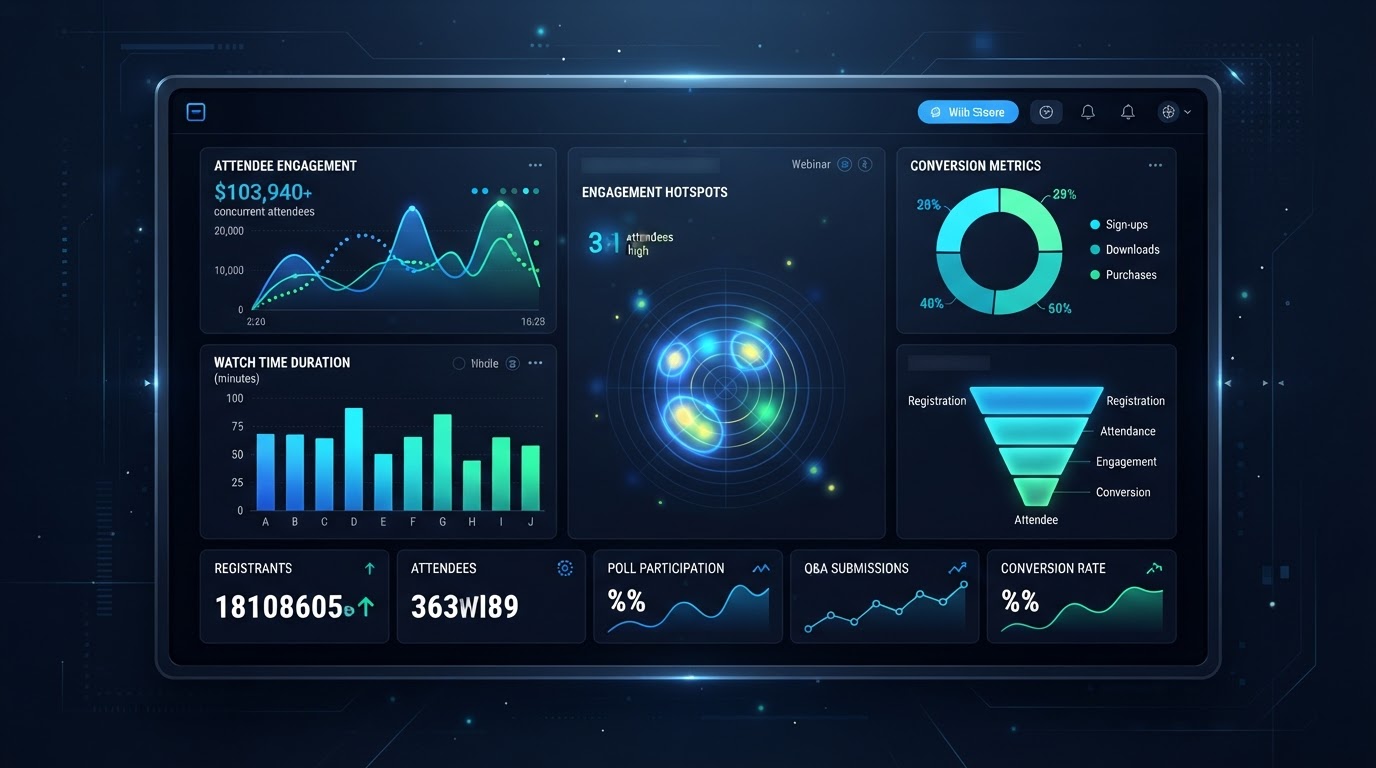


Every action an attendee takes during a webinar is a signal. When they register, that is a signal. When they attend, that is a signal. When they watch 80% of the presentation, ask a question, and click the offer — those are signals. The problem is that most businesses do not read these signals. They track registration and attendance, then treat every attendee the same.
Attendee behavior is the most accurate predictor of conversion available. It is more accurate than demographic data, more accurate than self-reported qualification, and more accurate than the registration form. Here are the behaviors that matter, what they signal, and how to use them.
The behavior-to-intent map
Each attendee behavior maps to a level of intent. Understanding this mapping allows you to segment attendees by their likelihood to convert — and to follow up accordingly.
- Registration without attendance — low intent. The person had initial interest but it decayed. They need the replay and a reason to re-engage.
- Attendance with early drop-off (under 25% watch time) — low to medium intent. The person attended but the presentation did not hold them. They need content related to the part they missed.
- Attendance with partial viewing (25-75% watch time) — medium intent. The person was interested enough to stay for part of the presentation but not enough to finish. They need re-engagement content.
- Attendance with full viewing (75%+ watch time) — high intent. The person invested significant time. They are the most likely to convert. They need a direct call to action.
- Question asked during the webinar — high intent. The person was engaged enough to participate. The question's content reveals what they care about. They need a response tailored to their question.
- Offer clicked — very high intent. The person wanted to act. They are one objection or one reminder away from converting. They need immediate follow-up with risk reduction.
These behaviors are not independent. An attendee who watches 90%, asks a question, and clicks the offer is the highest-intent lead possible — a combination of signals that strongly predicts conversion. An attendee who registers, never attends, and does nothing else is the lowest. The combination of behaviors creates an intent score that is more accurate than any single signal.
What questions reveal
The content of an attendee's question is as important as the act of asking. Different questions signal different stages of the buying journey.
- Educational questions ('How does this work?') — the attendee is in the learning stage. They need more education before they are ready for the offer.
- Comparison questions ('How is this different from X?') — the attendee is evaluating alternatives. They need differentiation content and may be close to a decision.
- Pricing questions ('How much does this cost?') — the attendee is in the buying stage. They are evaluating whether the value justifies the cost. They need the offer with clear pricing and risk reduction.
- Implementation questions ('How long does setup take?') — the attendee is past the buying decision and thinking about execution. They are very high intent. They need a direct path to purchase or onboarding.
In an AI-powered webinar, the AI Q&A captures these questions and the system can route attendees based on the question type. An attendee who asks a pricing question can receive a follow-up with pricing details and a booking link. An attendee who asks an educational question can receive a follow-up with more educational content. The question's content drives the follow-up — automatically.
Attendee behavior is the most accurate predictor of conversion. Registration, watch time, questions asked, and offer clicks each signal a different level of intent. The combination creates an intent score that is more accurate than any form field. Read these signals, and you know exactly who to follow up with and how.
Drop-off points as behavioral signals
When an attendee drops off is itself a behavioral signal. An attendee who drops off at minute 5 is signaling that the introduction did not hold them. An attendee who drops off at minute 25 — right before the offer — is signaling that they were interested in the content but lost interest before the call to action. An attendee who drops off during the offer is signaling that the offer did not resonate.
These drop-off points are actionable. If attendees consistently drop off at a specific section, that section needs restructuring. If they drop off before the offer, the presentation needs to build more desire before the CTA. If they drop off during the offer, the offer itself may need adjustment. The drop-off data tells you exactly where the presentation loses people — and where to fix it.
Using behavioral data for follow-up
The most direct application of behavioral data is in the follow-up. Instead of sending the same email to every attendee, segment by behavior and send different messages. The full viewer who clicked the offer gets a direct booking CTA. The partial viewer gets re-engagement content. The no-show gets the replay. The question-asker gets a response tailored to their question.
This behavioral segmentation is what makes webinar follow-up effective. Generic follow-up treats all attendees the same and converts poorly. Behavioral follow-up treats each attendee according to their demonstrated intent and converts significantly better. The data is already there — the webinar captured it. The question is whether your follow-up system uses it.
The long-term value of behavioral data
Over time, behavioral data accumulates into patterns. You learn which sections of the presentation consistently lose attendees. You learn which questions come up most frequently. You learn which behaviors most reliably predict conversion. This data improves not just the follow-up but the webinar itself — and the marketing strategy that drives traffic to it.
A business that runs webinars for a year with behavioral tracking has a dataset that reveals what their audience actually cares about, what drives conversion, and where the funnel leaks. That dataset is more valuable than any market research or persona exercise — because it is based on real behavior, not assumptions. The longer the webinar runs, the more data accumulates, and the better the optimization.
See AI webinars in action
Watch how WebinarBoostAi creates, presents, and engages with webinars using AI.
Book A DemoFrequently Asked Questions
What is webinar attendee behavior?
Attendee behavior is the set of actions an attendee takes during and after a webinar: registering, attending, watch time, questions asked, polls answered, and offer clicks. Each behavior signals a different level of intent. The combination creates an intent score that predicts conversion more accurately than any form field.
What webinar behaviors predict conversion?
Full viewing (75%+ watch time), asking questions, and clicking the offer are the strongest predictors. An attendee who does all three is the highest-intent lead possible. The content of questions also matters — pricing and implementation questions signal later-stage buying intent than educational questions.
How do I use attendee behavior data?
Use it for behavioral follow-up segmentation: full viewers get a direct CTA, partial viewers get re-engagement content, no-shows get the replay, and question-askers get a response tailored to their question. Also use drop-off points to identify which sections of the presentation need restructuring.
What do webinar questions reveal about attendees?
The question type signals the buying stage. Educational questions ('how does this work?') indicate the learning stage. Comparison questions ('how is this different from X?') indicate evaluation. Pricing questions indicate the buying stage. Implementation questions indicate post-buying execution — very high intent.
Why is behavioral data better than demographic data for webinars?
Behavioral data is based on what the attendee actually did, which is a direct signal of interest. Demographic data assumes people with similar titles or industries have similar needs — they often do not. Behavior reveals real-time intent without requiring the attendee to fill out forms or self-segment.