
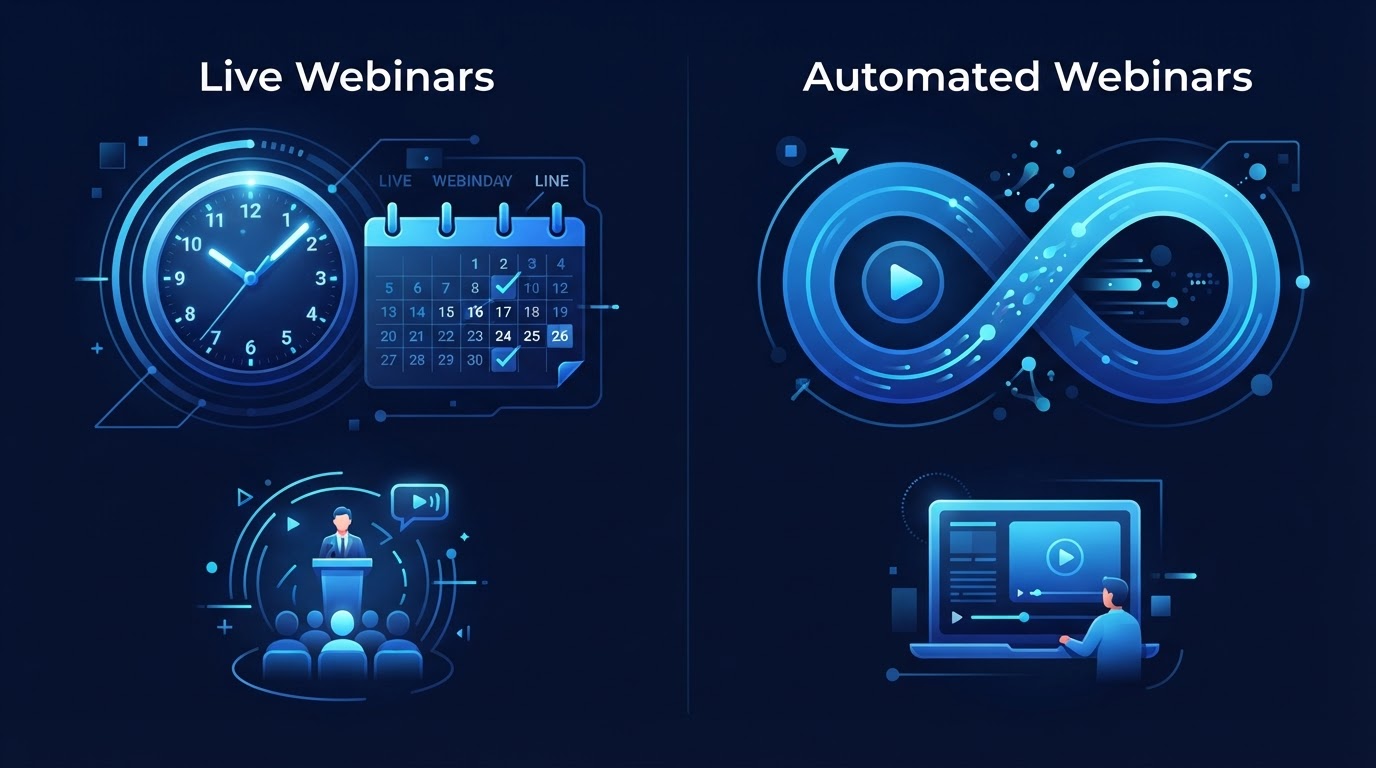
The debate between live and automated webinars is usually presented as a choice between two things: the authenticity and engagement of live, or the scalability and convenience of automated. This framing is too simple. The real question is not which format is better. It is which format is better for your specific goal, audience, and offer — and whether you actually have to choose.
What live webinars do well
Live webinars build trust through presence. The attendee knows the presenter is there, in real time, answering questions as they come. This creates a level of engagement that a recording cannot fully replicate. For high-trust sales — enterprise deals, expensive consulting, relationships that require a human connection — the live format signals commitment and availability in a way that scales poorly but converts deeply.
Live webinars also allow spontaneity. The presenter can read the room, adjust the pace, go deeper on a topic the audience cares about, and handle objections in real time. For complex topics where the audience's questions are unpredictable, this flexibility is valuable.
The weakness is scalability. A live webinar requires the presenter's time for every session. It requires scheduling. It requires promotion to fill each session. And it creates a ceiling: you can only run as many webinars as you have presenter-hours. For a business that wants webinars to be a continuous acquisition channel, not an occasional event, live alone is insufficient.
What automated webinars do well
Automated webinars scale. One presentation runs forever. Attendees register and attend on their schedule, not yours. The webinar becomes a persistent asset — always available, always capturing leads, always presenting the offer. For businesses that want webinars to run continuously without bottlenecking on a person's calendar, automated is the only format that works.
The traditional weakness was engagement. The chat was silent. Questions went unanswered. The attendee felt like they were watching a recording, not participating in an event. This is the gap that AI Q&A closes — by answering questions in real time, the automated webinar becomes interactive without requiring a human in the chat.
With AI engagement, the automated webinar's weakness is largely addressed. The presentation scales. The engagement scales. The follow-up scales. The only thing that does not scale is the live spontaneity — and for most webinar content, spontaneity is less valuable than consistency. A well-structured presentation delivered the same way every time, with questions answered by AI, often converts better than a live session where the presenter forgot a key point or rushed a section.
The honest comparison
Neither format is universally better. The right choice depends on three factors: your goal, your audience, and your offer.
- Goal — if the webinar is a top-of-funnel educational asset that should run continuously, automated. If it is a high-stakes conversion event for a specific cohort, live.
- Audience — if the audience is large and continuously arriving, automated. If the audience is small, high-value, and relationship-driven, live.
- Offer — if the offer can be presented clearly without a human in the room, automated. If the offer requires a human conversation to close, the webinar should feed into a consultation regardless of format.
The best answer is usually both. Run automated webinars continuously for scale. Run live webinars periodically for the audiences and offers that demand presence. Use the same presentation for both — created once, delivered live when it matters and automated when it scales.
The hybrid approach
The most effective webinar strategy is not live or automated. It is both, from the same presentation. Create the webinar once. Run it as an evergreen or just-in-time automated session for the majority of attendees. Run it live periodically — monthly or quarterly — for audiences who value presence and for offers that benefit from real-time Q&A with a human.
This approach gives you the scalability of automated and the trust of live, without choosing between them. The automated sessions capture the continuous flow of leads. The live sessions deepen relationships with the highest-value prospects. The same content powers both, so the production cost is paid once.
A platform that supports both formats from a single created webinar — where the same presentation runs as evergreen, just-in-time, and live — makes this hybrid strategy practical. You do not maintain separate assets for live and automated. You maintain one webinar and choose the format per session.
What the data says
Without proprietary data, it is irresponsible to claim specific conversion rates for live versus automated. The honest answer is that conversion depends more on the presentation quality, the offer, and the follow-up than on the format. A well-structured automated webinar with AI Q&A and behavioral follow-up will outperform a poorly structured live webinar. A well-run live webinar with a strong presenter will outperform a poorly structured automated one.
The format is a multiplier, not the base. The base is the content. Get the content right, and either format can work. Get the content wrong, and neither format will save you. Choose the format that lets you run the webinar at the frequency your business needs — then invest in the content, the engagement, and the follow-up that actually drive conversion.
See AI webinars in action
Watch how WebinarBoostAi creates, presents, and engages with webinars using AI.
Book A DemoFrequently Asked Questions
Do automated webinars convert better than live webinars?
It depends on the goal, audience, and offer. Automated webinars scale continuously and, with AI Q&A, can be interactive. Live webinars build deeper trust through presence. A well-structured automated webinar with good follow-up often outperforms a poorly structured live one. The format is a multiplier; the content is the base.
What is the advantage of live webinars?
Live webinars build trust through real-time presence and allow spontaneity — the presenter can adjust pace, go deeper on topics, and handle objections in real time. This is valuable for high-trust sales and complex topics where audience questions are unpredictable.
What is the advantage of automated webinars?
Automated webinars scale. One presentation runs forever, capturing leads on every attendee's schedule. With AI Q&A answering questions in real time, the traditional weakness — the silent chat — is addressed, making the experience interactive without a human in the chat.
Should I run live or automated webinars?
Usually both. Run automated webinars continuously for scale. Run live webinars periodically for high-value audiences and offers that demand presence. Use the same presentation for both — created once, delivered live when it matters and automated when it scales.